Iliou Melathron

In their “A Walk on the Wild Side: Urban Ethnography Meets the Flâneur”, Jenks and Neves remind “not forget the expressed intention of producing a description, a comment, the intention of expressing feelings”. Walking into the “Iliou Melathron”, a neoclassic building created by a german architect Ziller, located in the center of Athens in Panepistimiou street, I attempted to observe any images and symbols of the place. As Jenks and Neves explain, “psychogeography” is achieved through the “derive”, the “seeing” and “being drawn into events, situations and images by an abandonment to wholly unanticipated attention”. This was a neoclassic jewel of the city from the past (1881) which is still brilliant today. I noticed ancient symbols such as the swastika motif before it was abused by the Nazis, a geometric figure also found in Troy according to the findings of Schliemann, the owner of the building. Grapes, also carrying many symbolisms such as fertility and prosperity.
I cannot hold myself as I wander from wondering: Does Athens today still embrace the Dionysian fertility of past centuries?
This building is now very close to a modern one, much less representative of the urban ethnography (a description of a specific human culture) of that time but is still offering a spectacle between the 19th century and the 20th century.

by Marion Polemis
Modernity
By adopting the eyes of a modern flâneuse while walking through Athens allowed me to notice that this city has fragments from old and new modernity. Brilliant artifacts assorted with newly built structures hold a great relevance in my eyes with what Baudelaire wrote in “The Painter of Modern Life”. By directing our interest towards the modern architecture of our time, we may notice how architects appraise and honor the lines of the past.
As Baudelaire mentioned: “Casting an eye over our exhibitions of modern pictures, we are struck by a general tendency among artists to dress all their subjects in the garments of the past.”. Who are the artists of our modern time? Architects certainly play an important role among others. The architects of today learn from the architects of the past to rebuilt the modern. As Baudelaire mentions, “it is an excellent thing to study the old masters in order to learn how to paint”.

by Marion Polemis
The Academy of Athens

The Academy of Athens. A neoclassical building in the center of Athens. It was founded in 1856 and was designed by Hansen. It was deemed as the finest work of Hansen and as the nicest neoclassical building in the world. It is a spiritual foundation which promotes Science, Fine arts, and scientific studies. Nowadays, in the Academy operate 14 Research centers, and 6 Offices of research with specialized libraries. Since 2002, under the surveillance of the academy, runs the Biomedical Institution.
by Skartsilakis Emmanouil
Theater of Arts


Karolos Koun. A Greek theatre director born in 1908 in Asia minor. He is famous for establishing the Theater of Arts, located in and also famous for his ancient Greek plays. He founded the theatre in 1942 but due to the economic and war crisis in Greece, he had to close it in 1949 and re-establish it in 1954. During that period, Koun worked together with the National Theater of Greece. He was nominated with the medal of the Phoenix, the Silver Medal of the Academy of Athens and the Nations Theater award. He passed through his will the theatre to others in order to continue his legacy. To honour him, a theatre award was named after him. He died in 1987.
by Skartsilakis Emmanouil
The Runner

The Runner. Created by Varotsos in 1988 during an art campaign. It is made of glass and iron, it is 8 m. tall and was designed that way in order to be place in selected areas of the city. It was supposed to be placed in order to make people be aware with modern art in modern Greece. First, it was placed in Omonoia square where it was placed for a longer period of time than anticipated and instead of being embraced by people, it was criticized, and it was not accepted as a sculpture and so it was removed. Many people were fond of it, however many people were against it. Through time, it developed static problems and had to be fixed or it would collapse. Another reason The Runner was removed from Omonoia is because of the Metro. Now, it is located near Hilton hotel in Vasilissis Sofias street.
by Skartsilakis Emmanouil
Strolling in Omonoia


I have never imagined that by walking in a slow pace i would be able to witness so many things that i did not observe before, and trust me, they were many. With Anastasia we saw that all the central streets were named after very important people that played a role in Greece’s development. Omonoia at first glance is a weird area, neo-classical buildings mixed with old buildings that are monstrosities, abandoned manors next to modern buildings or vice versa. The smells were totally mixed. Because the area has a lot of refugees, they own shops where they cook their cuisine which is not similar to ours, thus, at first the smell is weird, but it attracts you because it is not bad! However, all that nice smell you seek to find where it comes from is quickly substituted with the smell of urine which comes from abandoned places that exist there. We also witnessed many statues, poorly preserved unfortunately, of people that we did not know but we found out that had a role in the development of Greece too, like George Canning. Out of the blue, interesting arcades emerged which were almost summoning you to walk in and discover new things. We were also amazed that many public services and banks were located in neoclassical buildings. On the one hand it is a pity to see such a beautiful house not to be a house anymore, on the other hand, these services protect them and preserve them. Being a Flaneur i believe it opened our eyes to a new world.
by Skartsilakis Emmanouil
George Canning

Ethnography is the systematic observation of culture, and culture is the behavior of people. Adjusting to the wild side of the city mentioned by Jenks and Neves as a flaneur, I discovered many interesting things. In the city center lies the statue of a person who played an important role in the history of Greece, George Kanning. Long story short, he was a British politician who helped sign the peace treaty between Greece and Turkey What draw my attention at first was the posture he had and all the details of the statue. As i was observing it, i saw that someone had dropped paint on the statue and also the engravings were a bit damaged, not to mention the smell of urine. Unfortunately, this is something that you witness now in Greece. Total disrespect in historic monuments
the State does nothing to repair or maintain them. 30 years ago almost all of the monuments were standing haughty and now everything is decaying. As you can witness on my photos, another neoclassical building was covered by a sports advertisement instead of using a net to cover the ruins which could have a depiction of the building at its initials state.
So, overall a flaneur should not just stroll incognito and observe but also understand why some things are happening and changing from time to time.
by Skartsilakis Emmanouil
The old in the new

Wandering around the city of Athens is always challenging. Even if you walk the same street again and again, you will always find something new that you did not see before. As Massey mentions in his book Places and their pasts, “The identity of places is very much bound up with the histories which are told of them, how those histories are told, and which history turns out to be dominant.” what caught my attention was a bronze statue of a walled book in Stadiou street. At first i thought it would mention something philosophical or so, hence the book, however, it was about a nazi headquarters built by Greeks who were traitors during the 2nd World War. More specifically, the organization was called Ethnosocialist patriotic organization which was founded by Vlavianos. These headquarters did not last long. They were obliterated by another resistance organization called the Panhellenic Union of Fighting Youths who wanted to help Greece which had already suffered a lot. So, that monument might not have a kind of history that you want people to know because it depicts the dark fragments of our past, however, it still is part of our history whether we like it or not.
by Skartsilakis Emmanouil
Syntagma

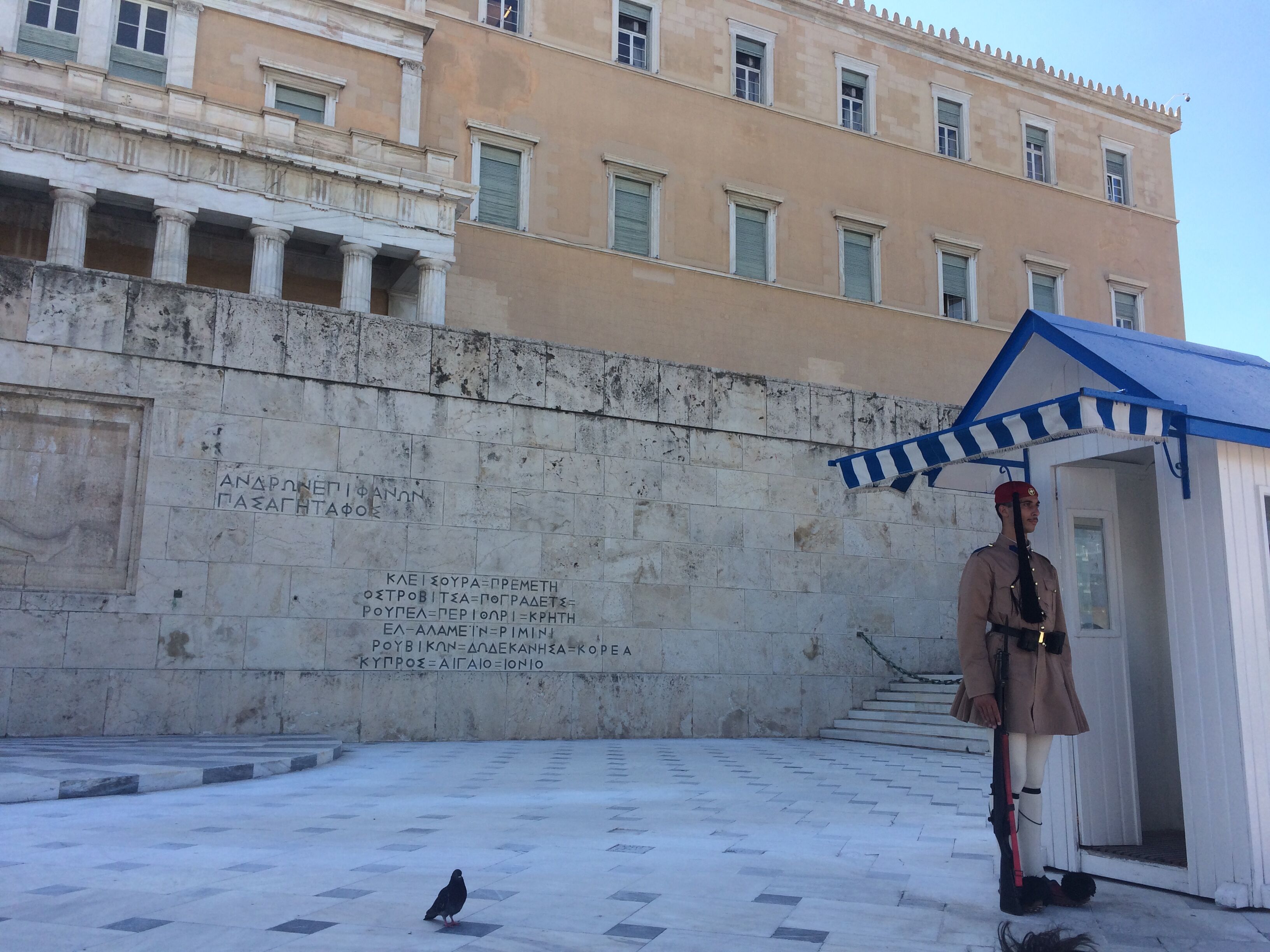
Syntagma is the central square of Athens. It houses the Greek Parliament since 1934.
by Marion Polemis
Honor to Rebetiko
Today the term is commonly used to describe an urban folk song style that originated in the beginning of the 20thcentury in the great ports of the Aegean Sea.

Historical periodisation proposed by Gauntlett (1985):
1.End of 19th century – 1920: oral non-commercial tradition.
2.1920 – 1936: first recordings and personal compositions.
3.1936 (the imposition of censorship by Metaxas’ regime) – 1941 (the invasion of Axis allied military forces).
4.1941-1946: the occupation years (World War II).
5.1946-1952: the popularization of rebetiko music (the emergence of arhondorebetiko, bourgeois-rebetiko style).
6.The 1960s-1970s: the first revival of early rebetiko music among urban intellectual circles. 7.1980s-up to today: 2 second rebetiko revival.
Rebetiko music-making between the years 1920-1936 is basically framed by two historical events: the population exchange (1922) that followed the Asia Minor War and the Metaxas’ dictatorship that imposed a censorship on rebetiko song (1936).
source: Tragaki (2007)
by Marion Polemis
What Used to Be: Places and their Pasts
Written by: Tiffany Lowery
While reading “Places and their Pasts” by Massey the main observation that stuck out to me was how past and present coincide. For example, the old Ottoman mosque in Monastiraki square is a major building but, it made me wonder if this was always that way. This was originally a mosque but it does not function as a mosque anymore. Another thing that stuck out to me was this building did not exist at some point in time. Maybe the square I was standing in was not even the same atmosphere as today. The other picture is of the Herod Atticus music theater below the Acropolis. The building is obviously old but I wondered what it looked like originally. There are drawings of how it looked when it was fully intact but seeing it with your own eyes is always different. I realized that the “modern” buildings and shops we have now will not always look the way they at present. It really made me contemplate how new buildings like the Acropolis museum with more modern architecture is right next to the musical theater with an older style of architecture. Looking at an older building might tell one story, but if you think of what it might have been in its prime you unlock different opportunities for the same place.

The Underdogs of the City
Written By:Tiffany Lowery

During the reading of The Walk on the Wild Side , the main idea that stuck out to me was the notion of an underdog in the city or of “no go” places people tend to avoid. When I walk as a Flaneuse I realize that these things become more and more interesting if looked at longer than a glance. For example, the picture taken of the homeless person’s belongings next to graffiti give the illusion of danger or an area that is unsafe to be in. However, when looked at a distance the graffiti was simply someone’s tag and a person’s home. The humanity is often taken out of context when dealing with areas that are normally thought of as off limits. The pictures were taken in Omonoia Square which I was previously told not to visit because of the high crime rate and pickpockets. Although this might be true Omonoia has a charm that other squares do not. The second image is of a building that has been worn and neglected. I took this as a representation of the underdogs of the city. Since this building is not a “pretty” or has significant historical value, that we know of, then it is deemed unimportant or a nuisance. It is an underdog because not many people stop to look at this building and wonder why or what it is. The detail of this building is intricate and different but cannot be noticed in a two-second interval. It also has a charming quality of having only some of the building repainted while the other part is peeling. It has “layers” so to speak and is not normally examined because it is an underdog.

Acropolis Walk
Written by: Tiffany Lowery
As we walked along the pathways of the Acropolis, I tried to look closely at things others might miss when normally focusing on the surface image of Athens. The main thing I noticed was a mix of touristy and local places coinciding. While I was walking, I kept seeing many musicians or artists selling jewelry or handmade goods to foreigners. However, as we kept walking the pedestrian path, I noticed the stands turned into full shops with antiques and locals buying things from the secondhand shops. Although the two were fairly close to each other the atmosphere changed drastically. I was amazed by how turning a corner in Athens can create a different result depending on the person or area. Some places were covered with graffiti and stray cats or dogs, then we would walk two blocks or so and be in a historical area. The combination of performers intrigued me as well, hip-hop dancers to the violinist playing classical music all within a block of each other. It made me realize that Athens is really a mash-up of all different things, especially people. I noticed so many different types of people concurring together. The old with the young, rich amongst the poor, refugees with vacationers, it allowed me to see the layers of Athens and the complexity it really holds.

Slowing Down in Omonia Square
Written by: Tiffany Lowery
The process of walking as a flâneuse opened my eyes that slowing down is foreign not only to me but everyone around me. In everyday life, the main way to live is to keep a high-speed style of life. Especially in the middle of Athens a city that moves quickly and efficiently to accommodate to everyday life.
There were families, workers, tourists all in a rush to somewhere they deemed important. However, I notice that moving fast hindered my ability to see the real people and places of Omonoia Square. From perceiving the city slow I began to see graffiti, homeless, and trash. These are normally unpopular picture opportunities yet when taken a closer look at becomes quite beautiful. Graffiti on the walls is not only on the old areas of the city but on modern buildings as well. Some are covered up or painted over, others left to make a statement. Normally, graffiti is a nuisance, but I saw today that they are voices of people around the city. They speak for the ones who are unheard or would like to make a change. On the other hand, some graffiti is there with no message or art and just profanity. When walking quickly the profanity is more apparent and seems to be everywhere.
Slowing down helped me to see the marriage of old and new buildings equally covered in graffiti. The main exception to graffiti is the banks which are normally in grand older buildings. This made me wonder why is one building taken more care of then an equally important building like the museum. The museum did not have graffiti on the front of the building but on the back and around the sides was brushed with the street. Another observation was homeless around the city, how people look at them but do not really see them. The homeless had mattresses and bags and areas claimed by them. However, people seemed to walk past there homes as if they were not intruding, not giving the people a second glance. The people living on the streets seemed unbothered by this because it is everyday life for them but for myself, I normally do not see or really reflect on these people besides just walking past them. When walking fast one sees many beautiful things in Omonoia Square like architecture, statues but can miss the true grit and rawness of the city, the unattractive perfection.

Metropolitan Cathedral of Athens

Few churches in Athens are as large or as spacious as the Metropolitan Cathedral of Athens. However, its size is not what caught my eye, but what surrounded the church, or the lack of. This church, and almost every other church in Athens, has a plaza surrounding it. Even the oldest churches, like the one in Monastiraki, has a plaza built around it. Churches that are old like the one in Monastiraki, have the plaza incorporated around it, while the newer churches like the Metropolitan Cathedral of Athens or Agia Paraskevi have the plaza incorporated to the church. It shows to me as the observer, that the church extends past the building, and plays a role in its own surrounding.
By: Jacob High
Old Amongst the New

Flâneur: Someone who walks among the city, as a keen observer of their surroundings, moving among the crowd. I have lived in Athens a month, as a student, a tourist, but not a flâneur. My first walk through Omonia, as a flâneur, was very different from my normal strolls. For one, I took my time walking, and two, I perceived modern antiquity I had not noticed before. Modern antiquity, as opposed to ancient antiquity, is something of the current age. Unaccounted for markets appeared when I took my time, and the old amongst the new surfaced. Old neoclassical buildings were re-purposed as banks, and hotels became convenience stores. Bygone buildings that represented the past had their functions changed to match modernity. The largest example I saw of this was the cigarette advertisement sign, and it came as a surprise because cigarette ads are illegal in Greece. The ad still existed because of its age, but no longer was it considered an ad, but a part of Athens. Ruins of the past stood as part of the city, not special attractions, but as old living amongst the new. Whether it be the sidewalks, pillars, or old ads for cigarettes, modern clashed with the past.
Juicy

Walking throughout Athens I stumbled upon a juice shop. I’ve never seen a juice shop, and the juice I did see in stores was expensive. However, I was pleasantly surprised that the prices of the juice were ludicrously low at .80 euros per 100 mil liters. The image attached is what their company, “Loving Family”, means and stands for. The company was founded after the Greek financial crisis and prides itself on offering well-known brands at low prices. The company gradually gives low prices on juice, instead of jacking up the prices. Looking around the area surrounding the building, the company or at least where the building is situated is ironic and counter-cultural. It is ironic, because, the area around the shop is either closed down or run down. The irony stands in that this bright red building stands against capitalism by having lower prices than the market value. It is also being counter-culture, so by lowering its marginal profits instead of matching the market prices of its products.
Songs that Honor the Past
From Greek popular songs such as “Vrase tin rouba, ta swing” by Tsitsanis (1946), “Omorfi mou Athina” by Gounaris and Maroudas (1946) and “Londra, Parisi” by Traiforos and Rapitis (1944), Athens is represented in contrast to other capitals such as London, Paris and New York as an ideal place which cannot be compared with other ones but also a place who has faded and which is remembered with nostalgia and melancholy.
By celebrating its culinary products, sharing the smells of its nature, expressing their nostalgy of a home, mourning with “her” about her degradation and implying mythological figures who ones coexisted with joy among her, the authors facilitate the identity formation and strengthening of social connectedness of the Athenian citizens. Through their lyrics, they allow them to travel with honor in a city that no longer exists.
by Marion Polemis
 HSS 2220 Blog